SPY -1.48%
BND -0.02%
QQQ -3.01%
DIA +0.13%
VNQ +0.23%
GLD +0.16%
BTC -9.50%
AAPL -0.04%
GOOGL -3.53%
NVDA -4.32%
MSFT -0.22%
META +0.94%
AMZN -2.22%
TSLA -4.24%
UBER +1.95%
GS -2.19%
BAC -0.10%
JPM -0.03%
BRK.A +0.79%
COST +1.59%
XOM -0.97%
BABA -2.55%
WMT +1.58%
SPCX -1.82%
DIS +0.58%
F -1.08%
  • Discounts and special offers
  • Subscriber-only articles and interviews
  • Breaking news and trending topics

Already a subscriber?

By signing up, you accept Moneywise's Terms of Use, Subscription Agreement, and Privacy Policy.

Not interested ?

Taxes
Internal Revenue Service Building in Washington D.C., USA. Photo by Roman Babakin / Shutterstock

The IRS quietly released new tax brackets for 2027: Some Americans save thousands while Uncle Sam takes more from others. What about you?

While we adhere to strict editorial guidelines, partners on this page may provide us earnings.

Many factors determine how much you pay in taxes, but arguably the most important are tax brackets. The more money you make the higher your marginal tax rate, which means every additional dollar you earn beyond specific thresholds exposes you to more taxes.

These thresholds are adjusted every year for inflation and on November 5th the Internal Revenue Service released an official update (1) for all the changes due in the 2027 tax year. These new brackets could mean thousands of dollars in additional savings for some Americans, but for others, it could mean a bigger tax bill.

Advertisement

Keep more of your money — subscribe free.

By signing up, you accept Moneywise Terms of Use, Subscription Agreement, and Privacy Policy.

Here’s a closer look at how these changes could impact you.

New brackets for 2027

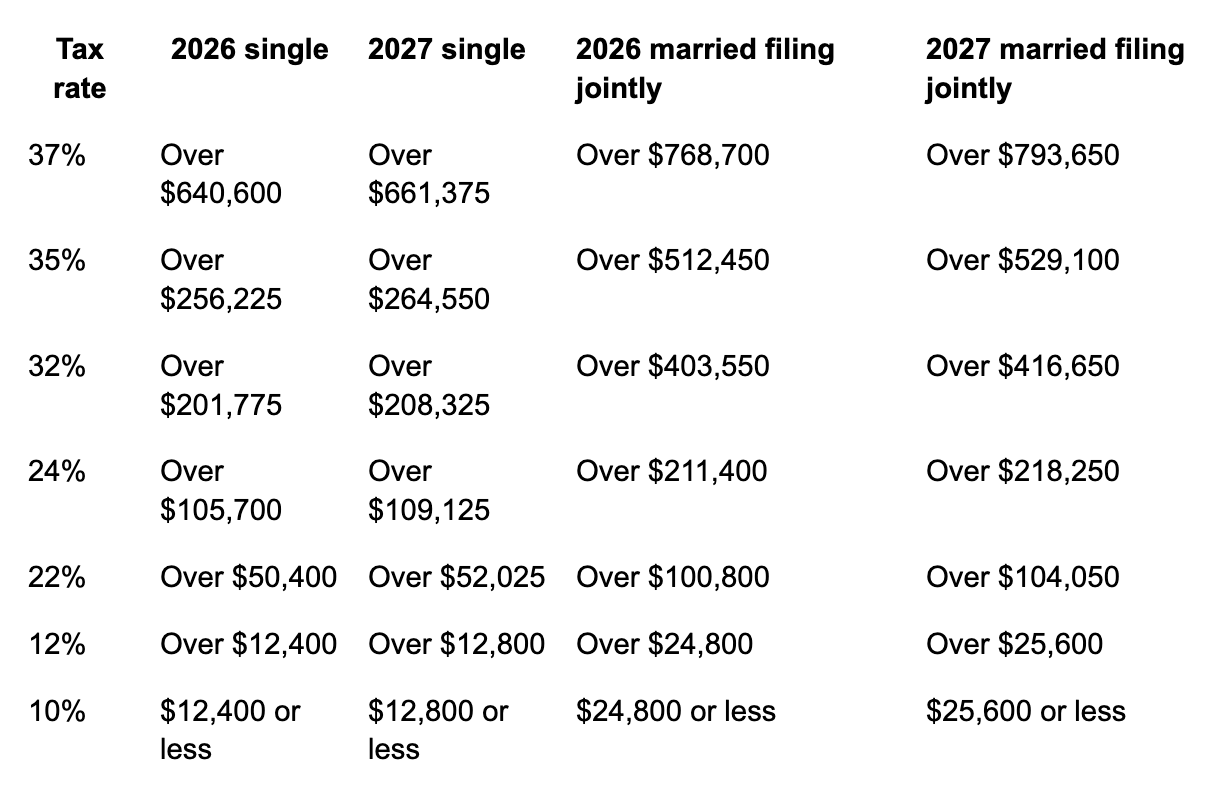
It’s important to note that the IRS is not changing the tax rates for 2027. All brackets have the same rates, starting at 10% and going through 12%, 22%, 24%, 32%, 35% and finally, 37%. The dollar amount you need to earn to hit each bracket is what’s changing. All amounts are increasing to account for inflation.

Here are the updated brackets for 2027:

2027 tax brackets IRS
IRS

Remember, these higher income thresholds do not mean a tax cut. Alex Durante, a senior economist at the Tax Foundation, told NBC Miami (2) that these annual hikes are intended to offset the impact of inflation, so that the declining value of money alone doesn’t push taxpayers into higher brackets.

With that in mind, how these changes impact you depends on how your income in 2027 is expected to change. If you expect to earn the same or even a little less next year, your tax bill could be a little lighter. If your income is rising modestly, in line with inflation, you shouldn’t expect much to change.

If your income is expected to grow faster than inflation, that probably means a bigger tax bill despite the adjustments.

Although next year’s income could be unpredictable for many, these updated tax brackets should give you enough information to start planning ahead and minimizing your taxes in 2027.

Advertisement

Must Read

Plan ahead

For millions of Americans, next year’s income is beyond their control. The size of their next pay hike or bonus depends on their employer. If that is the case for you, consider bumping up contributions to a traditional 401(k) or a health savings account. Pre-tax dollars are shielded at your highest marginal rate.

For those with flexible incomes, such as retirees or business owners, there are a lot more tools available to manage your reported earnings and stay within specific brackets.

You could, for instance, lower your withdrawal rate from your 401(k) plan to stay below a specific threshold in 2027, or reduce the dividend you pay yourself from the corporation you own.

Regardless of which group you fit into, these strategies can be complicated and there’s plenty of room for errors that can cost you much more in the form of penalties and surcharges. Working with a professional tax planner or financial advisor could reduce some of that risk.

Advisor.com can help get you connected with the right professional for free.

Advertisement

The platform does the heavy lifting for you, vetting advisors based on track record, client ratios and regulatory background. Plus, their network comprises fiduciaries, who are legally required to act in your best interests.

Just enter a few details about your finances and goals and Advisor.com’s AI-powered matching tool will connect you with a qualified expert best suited for your needs based on your unique financial goals and preferences.

Finding the right advisor isn’t always easy — there’s no one-size-fits-all solution. That’s why Advisor.com lets you set up a free initial consultation, with no obligation to hire, to see if they’re the right fit for you.

Once you’ve got the right professional in your corner, you can leverage tools like charitable donations, lower withdrawal rates, or IRA and 401(k) contributions with confidence.

If the IRS’ annual inflation adjustments have reminded you of your exposure to the cost-of-living crisis, you could add some gold to your portfolio to offset this risk.

Advertisement

Opening a gold IRA with the help of Goldco allows you to invest in gold and other precious metals in physical form while also providing the significant tax advantages of an IRA.

With a minimum purchase of $10,000, Goldco offers free shipping and access to a library of retirement resources. Plus, the company will match up to 10% of qualified purchases in free silver.

If you’re curious whether this is the right investment to diversify your portfolio, you can download your free gold and silver information guide today.

Article Sources

We rely only on vetted sources and credible third-party reporting. For details, see our ethics and guidelines.

Internal Revenue Service (1); NBC Miami (2)

You May Also Like

Share this:
Vishesh Raisinghani Freelance Writer

Vishesh Raisinghani is a financial journalist covering personal finance, investing and the global economy. He's also the founder of Sharpe Ascension Inc., a content marketing agency focused on investment firms. His work has appeared in Moneywise, Yahoo Finance!, Motley Fool, Seeking Alpha, Mergers & Acquisitions Magazine and Piggybank.

more from Vishesh Raisinghani

Explore the latest

Disclaimer

The content provided on Moneywise is information to help users become financially literate. It is neither investment, tax nor legal advice, is not intended to be relied upon as a forecast, research or investment advice, and is not a recommendation, offer or solicitation to buy or sell any securities, enter into any loan, mortgage or insurance agreements or to adopt any investment strategy. Tax, investment and all other decisions should be made, as appropriate, only with guidance from a qualified professional. We make no representation or warranty of any kind, either express or implied, with respect to the data provided, the timeliness thereof, the results to be obtained by the use thereof or any other matter. Advertisers are not responsible for the content of this site, including any editorials or reviews that may appear on this site. For complete and current information on any advertiser product, please visit their website.

†Terms and Conditions apply.