If you’ve ever felt like your drive-thru bag is lighter than it used to be, that may not be because you order less than you did in college.
McDonald’s Chicken McNuggets, Burger King Whoppers and Chick-fil-A chicken sandwiches were weighed against their average weights listed in an older U.S. Department of Agriculture database as part of an investigation by KIRO 7 in Seattle and Boston 25 News. On average, all three chains came up light in both cities.
At the same time, the financial burden of fast food got heavier. The cost of “food away from home,” the government’s catch-all for restaurant meals, fast food included, is up nearly 40% since 2019, according to the U.S. Bureau of Labor Statistics.
Thanks for subscribing!
The money news that actually matters.
By signing up, you accept Moneywise Terms of Use, Subscription Agreement, and Privacy Policy.
How the weigh-in worked
Each crew hit three locations of each chain — Boston, Dedham, Norwood, Walpole, Hudson and Milford in Massachusetts; Tukwila, Renton and Bellevue in Washington — bought three of each item in total and weighed everything out of the wrapper.
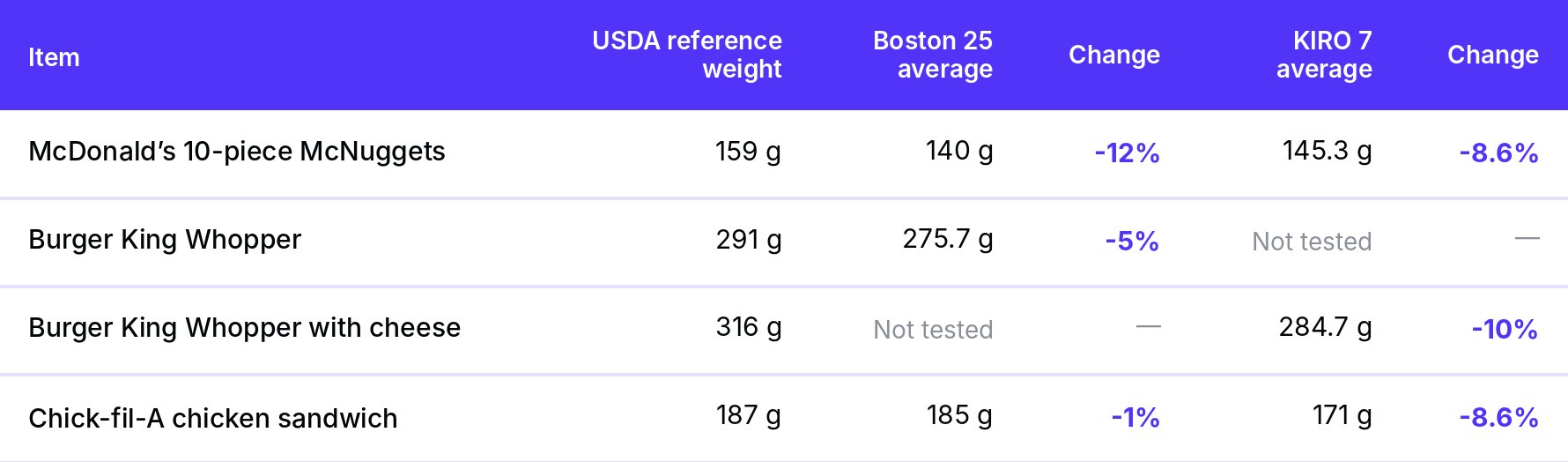
Here’s how the averages stacked up:
The reference weights come from an old USDA nutrition database. The stations call them 2019 figures, but USDA stopped updating it in April 2018, and much of the data is older than that.
Must Read
- Jeff Bezos backs a platform that lets anyone invest in rental homes for as little as $100 — 6 ways to build wealth like a landlord without actually being one
- The tax breaks in Trump's 'big beautiful bill' expire after 2028. Here are 4 moves to make before the window closes
McNuggets came up nearly 12% light in Boston
McNuggets had the biggest gap in Boston. USDA puts a 10-piece order at 159 grams, but Boston 25’s three boxes weighed 129, 155 and 136 grams. That’s an average of 140 grams, nearly 12% under.
That could be more than a whole nugget’s worth missing from the box.
Seattle’s boxes were closer but still short. KIRO 7’s weighed 152, 149 and 135 grams, an average of 145.3 grams, or 8.6% under.
Whoppers came up short, but Burger King has an explanation
The Whopper was light in both cities too, though the stations didn’t weigh the same burger. Boston 25 bought the classic Whopper, which USDA lists at 291 grams. Its three came in at 285, 278 and 264 grams, an average of 275.7 grams, or about 5% under.
KIRO 7 went with the Whopper with cheese, listed at 316 grams, and got 298, 279 and 277 grams. That averages out to about 285 grams, roughly 10% under.
Burger King told both stations the patty hasn’t changed and that it still serves “more than 1/4lb of 100% flame-grilled beef.” The chain did switch to a glazed bun earlier this year, which it said may slightly change the weight, and added that small differences come with making each sandwich fresh.
Chick-fil-A was nearly even in Boston but not in Seattle
In Boston, Chick-fil-A’s chicken sandwich nearly matched USDA’s 187 grams. Boston 25’s sandwiches weighed 152, 196 and 207 grams, so two of the three actually came in heavy, and the 185-gram average was only about 1% under.
Seattle’s were light across the board. KIRO 7’s weighed 181, 170 and 162 grams, an average of 171 grams, or 8.6% under.
Chick-fil-A said that, due in part to the handmade nature of its food and its use of whole boneless chicken breasts, “there may be variation in the size of chicken breast portions.” The chain added that preparation, supply sources and regional differences can also play a role, in a statement it sent to both Boston 25 and KIRO 7.
A small test with real limits
Each station bought only three of each item, so one big sandwich or skimpy box can move an average a lot. The benchmarks are old USDA numbers, not the chains’ own specs, and they may predate changes like Burger King’s new bun. Even McDonald’s nutrition fine print says variation in serving sizes, preparation and supply sources can affect its nutrition figures, and that its recipes change from time to time.
Edgar Dworsky, a Somerville, Massachusetts, consumer advocate who founded ConsumerWorld.org, made the same point to Boston 25: a scale only tells you so much, especially with chicken.
“Chicken filets are not stamped out at a factory,” he said. “They’re individual sizes and there’s going to be some variability.”
Still, across two cities and three chains, all six averages landed below the USDA reference weights.
Why fast-food chains are under pressure to shrink portions
None of this proves the chains trimmed portions on purpose, and the tests can’t say why the weights differ. Chains do have reasons to hunt for savings, though. They’re paying more for ingredients and seeing fewer customers.
Beef is a big one. Ground beef averaged $7.07 a pound in October, according to BLS data, up about 67% from 2019’s average of $4.23. Part of the problem is a shrinking herd: there were 86.2 million cattle and calves in the U.S. on Jan. 1, the fewest since 1951, according to the USDA.
Fewer people are also pulling into the drive-thru. McDonald’s U.S. same-store sales dipped 0.2% in the third quarter, with fewer customer visits mostly offset by people spending more per order. Across fast food, traffic fell 2.6% in the quarter, according to restaurant consultant Revenue Management Solutions. McDonald’s is testing new value bundles at 1,900 U.S. restaurants to win customers back, and plenty of diners have already cut back as menu prices climb.
When costs climb, a chain can charge more or serve less, and the second is easier to get past customers, University of Washington marketing professor Jeff Shulman told KIRO 7.
“If you raise prices, customers will notice, and there will be backlash,” he said. “If you shrink a nugget, maybe a nugget of your customers will notice, but not everyone will.”
Customers are catching on anyway, or at least they think so. In a September survey of 850 U.S. adults who eat out weekly, restaurant software company Toast found that half say restaurant portions have shrunk over the past year, and 79% say prices went up. Most of the people who noticed smaller portions were going by memory: 59% said the food just looked smaller, and only 15% had actually counted fewer pieces. Given the choice, respondents would rather a restaurant raise prices than shrink portions, and 61% said they wouldn’t put up with a cut of more than about 10%.
Dworsky thinks it goes beyond the three items the stations weighed. “I have no doubt that French fry portions at Burger King and other fast food places have probably gone down,” he told Boston 25. “People complain about it all the time.”
You May Also Like
- Dave Ramsey warns nearly 50% of Americans are making 1 big Social Security mistake — here’s what it is and 3 simple steps to fix it ASAP
- A single line on your car insurance policy could be inflating your premium by up to 30% — here's what to change
Rudro is an Editor with Moneywise. His work has appeared on Yahoo Finance, MSN, MSN Money, Apple News, Samsung News and the San Diego Union Tribune.