SPY +1.26%
BND +0.50%
QQQ +1.12%
DIA +0.62%
VNQ +0.48%
GLD -0.55%
BTC -0.39%
AAPL +0.25%
GOOGL +1.35%
NVDA +2.39%
MSFT +2.80%
META +1.85%
AMZN +2.61%
TSLA +2.05%
UBER +1.59%
GS -0.82%
BAC +0.77%
JPM +0.07%
BRK.A +0.45%
COST +1.68%
XOM +0.30%
BABA +1.75%
WMT +2.96%
SPCX +6.01%
DIS +1.68%
F +1.74%
  • Discounts and special offers
  • Subscriber-only articles and interviews
  • Breaking news and trending topics

Already a subscriber?

By signing up, you accept Moneywise's Terms of Use, Subscription Agreement, and Privacy Policy.

Not interested ?

Real Estate News
People moving into a new place Thomas A. Ferrara/Getty

The Fed risks triggering a ‘doom loop’ keeping rents high and homeownership out of reach, economist warns. Is he right?

People are worried about the cost of filling up their fuel tanks, but it’s the roof over their heads they should worry about, one economist warns.

Torsten Slok is chief economist at Apollo Global Management (NYSE: APO), a private equity firm with over $1 trillion in assets, including residential real estate.

Advertisement

As Fortune reports, Slok is warning of a “higher rent doom loop” if Federal Reserve Chair Kevin Warsh raises interest rates further.

The money news that actually matters.

By signing up, you accept Moneywise Terms of Use, Subscription Agreement, and Privacy Policy.

The new Fed chair raised rates in September — the first rate hike in more than three years — and indicated there could be more rate increases to come this year and next.

In a note, Slok wrote: “When rates are high, builders build less, and when fewer homes and apartments get built, rents go up, which pushes inflation higher and keeps rates high. Call this the ‘higher rates, higher rent doom loop.’”

He added that “this re-acceleration in rents is a problem for the Fed because it puts upward pressure on inflation driven by higher rates.”

So should Americans brace for rent hikes? Joel Berner, chief economist at Realtor.com, says no — at least not for a few years.

“I don’t think this is going to be an imminent problem,” Berner told Moneywise. “I think this is a few years down the road.”

Moneywise reached out to Apollo but did not receive an immediate response.

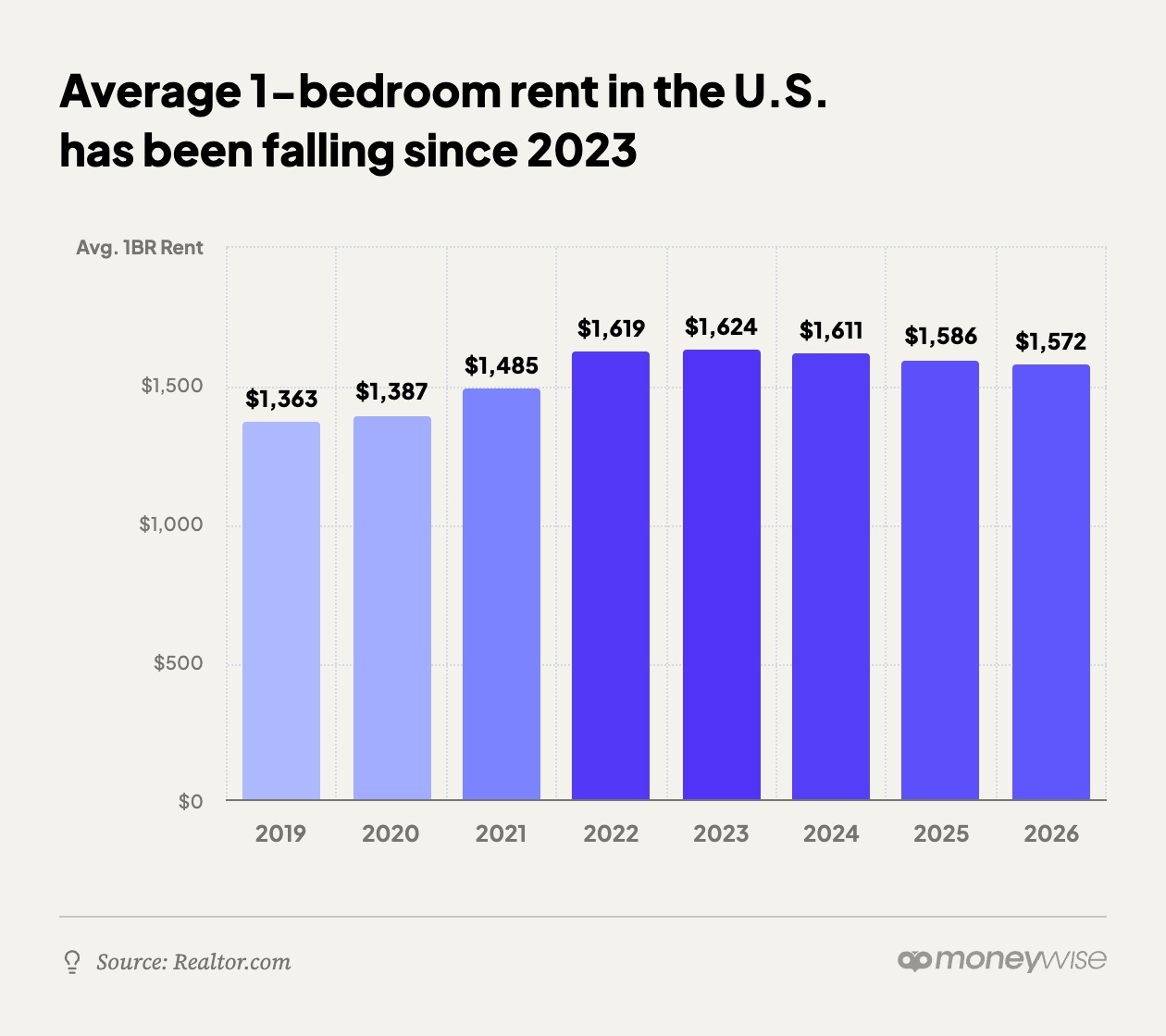
For now, rents are falling, not rising

Average 1-bedroom rent in the U.S. has been falling since 2023
Realtor.com

Berner suggests that Slok’s warning of a “doom loop” is missing some context about supply, demand and price (in this case, monthly rent).

“It’s really only a ‘doom loop’ if there are no forces acting against it,” Berner said.

Advertisement

He pointed to the impact of higher rents on rental construction, noting that builders tend to build more rental units as rents rise — even if interest rates are rising too — until the cost of construction (including interest rates) outweighs profit from rent.

For example, after the Fed slashed interest rates down to 0.25% in 2020, it increased them from 2022 on until the benchmark rate reached a high of 5.5% in 2023, per Forbes. Then the Fed started cutting rates again, right up until this September.

Throughout this period of both low and relatively high (still moderate) interest rates, rents remained higher than they were prepandemic. Builders built more rental units, as Stateline reports. By the spring of 2025, the number of new rental apartments had hit a 50-year high.

That resulted in increased supply, and rents began falling as of 2023 as supply began to outstrip demand. Realtor.com’s latest report shows that average rents fell for the 37th straight month in August. Even New York City’s average rents are flat, Berner reports.

The only cities, according to Berner, where rents are rising are:

Advertisement
  • San Francisco and San Jose, California, where the AI boom has created fierce competition for housing and driven rent increases of 4% year over year
  • Kansas City, Kansas and Pittsburgh, Pennsylvania, formerly affordable cities that have insufficient housing supply
  • And Chicago, Illinois, which likewise has not seen as much growth in rental supply

This doesn’t mean that interest rates will have no impact on housing, Berner notes.

Must Read

When and where higher interest rates may hit housing costs

Berner said that the time lag between a builder getting a permit for a rental complex and then financing to construction and completion is about five years.

While there are still construction projects in the pipeline, if the Fed raises rates every few months over the next year, builders would lose the incentive to build rental units, he said. That could reduce supply — and rents would rise again, but not for a few years.

Fortune reported that there are other factors besides interest rates affecting residential construction right now. For example, homebuilders are competing for skilled trades amid the AI data center boom. Tariffs are hitting builders as the cost of construction supplies — like lumber — soars.

Housing completions, including completion of rental buildings, were down 27.1% year over year in August, according to the U.S. Census Bureau.

So how could all these factors affect would-be homeowners? While rents may not go up for a while, homeowners could face a double whammy of higher mortgage rates due to rate hikes as well as more competition for a reduced supply of privately owned homes.

You May Also Like

Share this:
Laura Boast Senior Reporter

Laura Boast is a Senior Reporter with Moneywise.com and a lifelong content creator who has reached international audiences at Discovery, CBC, Blue Ant Media, Bond Brand Loyalty and more.

more from Laura Boast

Explore the latest

Disclaimer

The content provided on Moneywise is information to help users become financially literate. It is neither investment, tax nor legal advice, is not intended to be relied upon as a forecast, research or investment advice, and is not a recommendation, offer or solicitation to buy or sell any securities, enter into any loan, mortgage or insurance agreements or to adopt any investment strategy. Tax, investment and all other decisions should be made, as appropriate, only with guidance from a qualified professional. We make no representation or warranty of any kind, either express or implied, with respect to the data provided, the timeliness thereof, the results to be obtained by the use thereof or any other matter. Advertisers are not responsible for the content of this site, including any editorials or reviews that may appear on this site. For complete and current information on any advertiser product, please visit their website.

†Terms and Conditions apply.