• Discounts and special offers
  • Subscriber-only articles and interviews
  • Breaking news and trending topics

Already a subscriber?

By signing up, you accept Moneywise's Terms of Use, Subscription Agreement, and Privacy Policy.

Not interested ?

Top Stories
Artist Wyland, inset, talks about his "Whaling Wall" mural being painted over. Photo courtesy The Associated Press

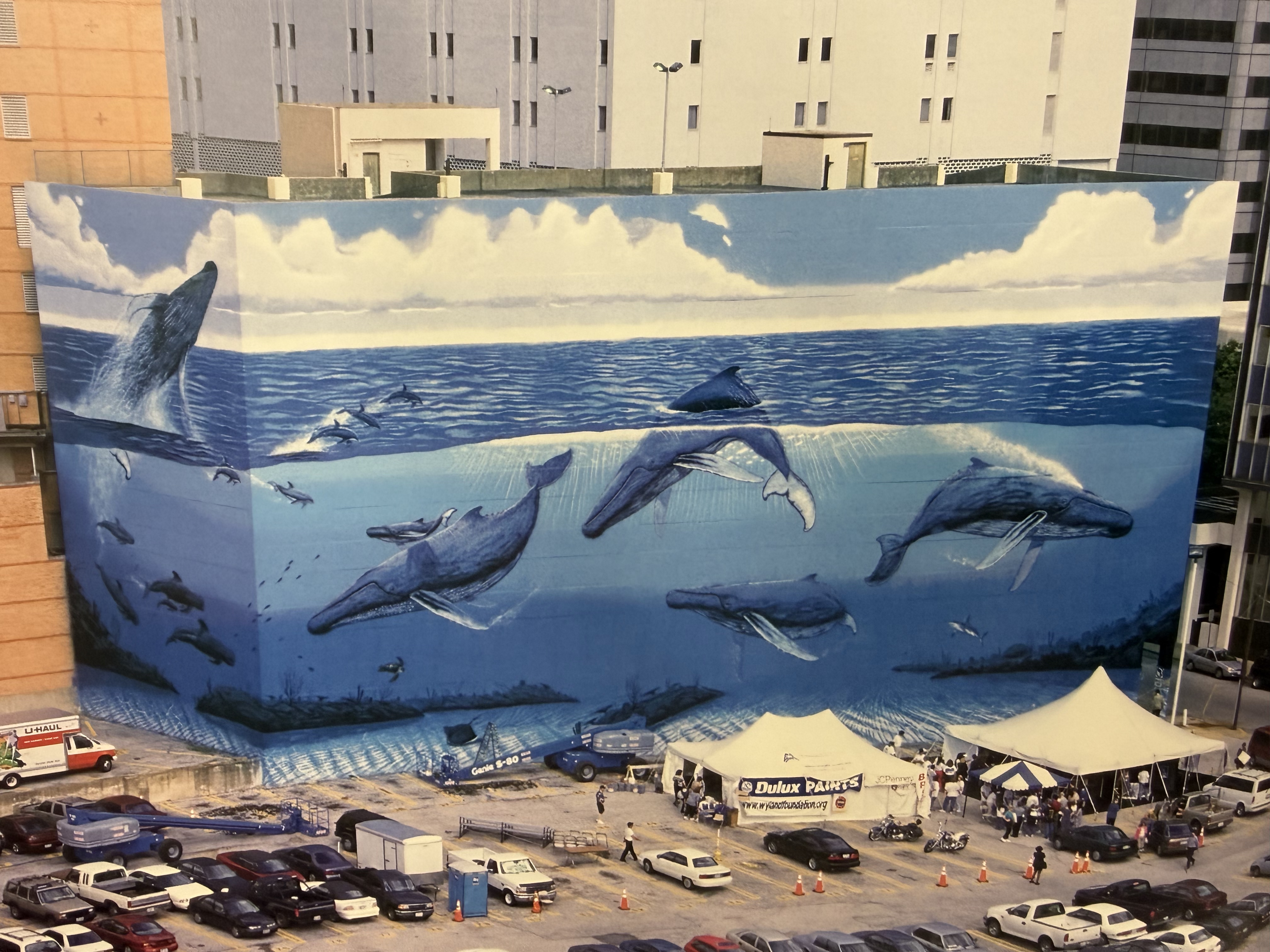
His whale mural was a fixture in Dallas for 27 years. Then it was painted over for the World Cup — now the artist is suing for $25 million

If you had whales, murals, Dallas and lawsuits on your World Cup gambling parlay, congratulations — you’re off to a great start on soccer’s most glittering global tournament.

That’s because artist Wyland filed a federal lawsuit in early June against FIFA, soccer’s global governing organization, and the owner of a Dallas building after his massive whale mural was whitewashed without his consent.

Advertisement

The 17,000-square-foot mural, which depicts whales swimming in the ocean, was painted over in favor of a proposed World Cup-themed image featuring artwork that “captures this current historical moment and reflects the energy, unity, and global spirit surrounding the World Cup 2026.” Organizers noted that a part of Wyland’s mural would remain on the downtown Dallas building.

The lawsuit, filed June 8 in U.S District Court, seeks $25 million in damages and relies heavily on the Visual Artists Rights Act, a 1990 federal law that protects artists’ rights on public works. In the filing, Wyland, who finished the mural in 1999, accuses FIFA and the building owner of “hastily and irrevocably destroying a civic landmark” to promote the soccer tournament, which will include matches in nearby Arlington, Texas.

“Though FIFA claims they were working to develop art for the host city, in truth, they defaced an historic fixture of the host city,” the artist’s lawsuit says.

In a June 9 statement, a FIFA spokesperson said the organization “has no involvement in this whatsoever” and directed legal inquiries to the tournament’s local organizing committee, which is also named in the lawsuit.

Does Wyland have a good shot at winning?

Wyland found out about the repainting through a contact who was present during the original 1999 painting. He reached out to Wyland through an assistant.

“It’s unrepairable now,” Wyland told NBC 5. “I mean, it absolutely, you know, destroyed the entire mural.”

Legal experts say the lawsuit’s chances may hinge on the specific contract between Wyland, the building’s owner and the city of Dallas.

Advertisement

“A contract may govern the parties’ rights, and could limit the rights of a property owner or a city to alter, remove, or cover a work of art. If there is no contract, then the parties’ rights are governed by the Visual Artists Rights Act. Indeed, an artist can waive whatever rights they might have under VARA,” Marc P. Mistahl, a copyright attorney at Offit Kurman in New York City, told Moneywise.

The interpretation of that law looms large in the lawsuit because VARA can provide what Mistahl called “meaningful protections.” VARA gives artists the right to prevent any intentional modifications that would harm their work. But it’s not just the impact on the artists themselves. There’s the community.


“FIFA comes in, part of a temporary event. They leave and take a civic landmark with them,” Wyland said, in an interview with Associated Press. “That’s what’s happening here, and thousands of people who have reached out to about it are just distraught.”

That said, VARA may not apply in the same way to artwork incorporated into a building. If incorporated visual art can be removed from a building with destruction or other modification, VARA requires building owners to provide notice to the artist in writing. Then the artist has 90 days to remove the work or pay for its removal.

Other legal experts note that property owners generally have broad authority over the use and management of their buildings. Wyland’s rights are under VARA.

“There are no Texas common law rights which cover it, with the exception of contract law, and that depends on the terms of the agreement,” Kenneth Eade, an attorney and consultant at Amazon Sellers Attorney Ltd. in Beverly Hills, California, told Moneywise.

Advertisement

Eade said any agreement that originally authorized the mural could contain enforceable provisions. That would include a preservation covenant, a removal-notice provision, and a right of first refusal to remove, as well as address any alterations or destruction.

The mural’s large size may also work in Wyland’s favor. VARA covers paintings, drawings, prints, sculptures and certain photographs existing in single copies or limited editions.

“A mural painted directly on a wall qualifies as a covered ‘work of visual art,’ so this threshold is likely met,” Eade added.

Another legal limitation is that the work must be of “recognized stature.” Wyland’s work has been on the property for 27 years and is part of a “Whaling Wall” series that he has painted in cities across the United States, including Portland, Oregon, Milwaukee and New York City.

Must Read

Join 250,000+ readers and get Moneywise’s best stories and exclusive interviews first — clear insights curated and delivered weekly. Subscribe now.

A Legal Precedent Is In Place

Wyland may also benefit from a notable 2020 court ruling. In February of that year, the Second U.S. Circuit Court of Appeals upheld the $6.75 million award by a lower court in Castillo v. G&M Realty L.P. for a willful violation of VARA.

“In that case, a building owner whitewashed graffiti art that was put on buildings at the owner’s request,” Mistahl said. “The artist will have to prove the stature of the work, likely through expert testimony and by showing how well-known the work was. This can be through testimony, the work being featured in TV shows and movies [and] articles about the work.”

Advertisement

Artist Maria Castillo also defined a work of recognized stature as one of high quality, status or caliber that has been acknowledged as such by a relevant community.

“Should the dispute drag on, this part of the analysis should prove the most onerous, though this case appears to have striking factual similarities to Castillo,” David Niemierzycki, an attorney at the law firm Adams and Reese, told Moneywise. “To counter these factual similarities, the defendants may attempt to distinguish the work in this case as having a ‘promotional’ or ‘advertising’ purpose, as in Second Circuit case Pollara v. Seymour, and/or being a ‘work-for-hire’, either of which would take it outside of VARA’s scope.”

If Wyland prevails, the case could make developers, property owners and event organizers more sensitive to artists’ rights or encourage them to seek broader VARA waivers.

“This is not the first case brought under VARA, so it is possible that this is just viewed as the cost of doing business,” Mistahl added. “If the defendants win, it could make artists less willing to produce such civic-minded works, or it could cause them to negotiate for stronger protections in the agreements they enter into.”

A jury could ultimately be asked to decide where to draw the line among economic development, event branding and the preservation of culturally significant art.

“This is a competing interest between sports, which are more than just money-making enterprises, but also a part of our culture, and major sports events such as FIFA are culturally important,” Eade said. “Art, which is unquestionably culturally important, and attention to environmental concerns, is something we should all be concerned about.”

You May Also Like

Share this:

A former Wall Street bond trader, Brian O'Connell is the author of two best-selling books: “The 401k Millionaire” and “CNBC’s Creating Wealth.” His work is featured on national finance and business platforms like TheStreet.com, CBS News, CNN, The Wall Street Journal and Forbes.

more from Brian O’Connell

Explore the latest

Disclaimer

The content provided on Moneywise is information to help users become financially literate. It is neither investment, tax nor legal advice, is not intended to be relied upon as a forecast, research or investment advice, and is not a recommendation, offer or solicitation to buy or sell any securities, enter into any loan, mortgage or insurance agreements or to adopt any investment strategy. Tax, investment and all other decisions should be made, as appropriate, only with guidance from a qualified professional. We make no representation or warranty of any kind, either express or implied, with respect to the data provided, the timeliness thereof, the results to be obtained by the use thereof or any other matter. Advertisers are not responsible for the content of this site, including any editorials or reviews that may appear on this site. For complete and current information on any advertiser product, please visit their website.

†Terms and Conditions apply.