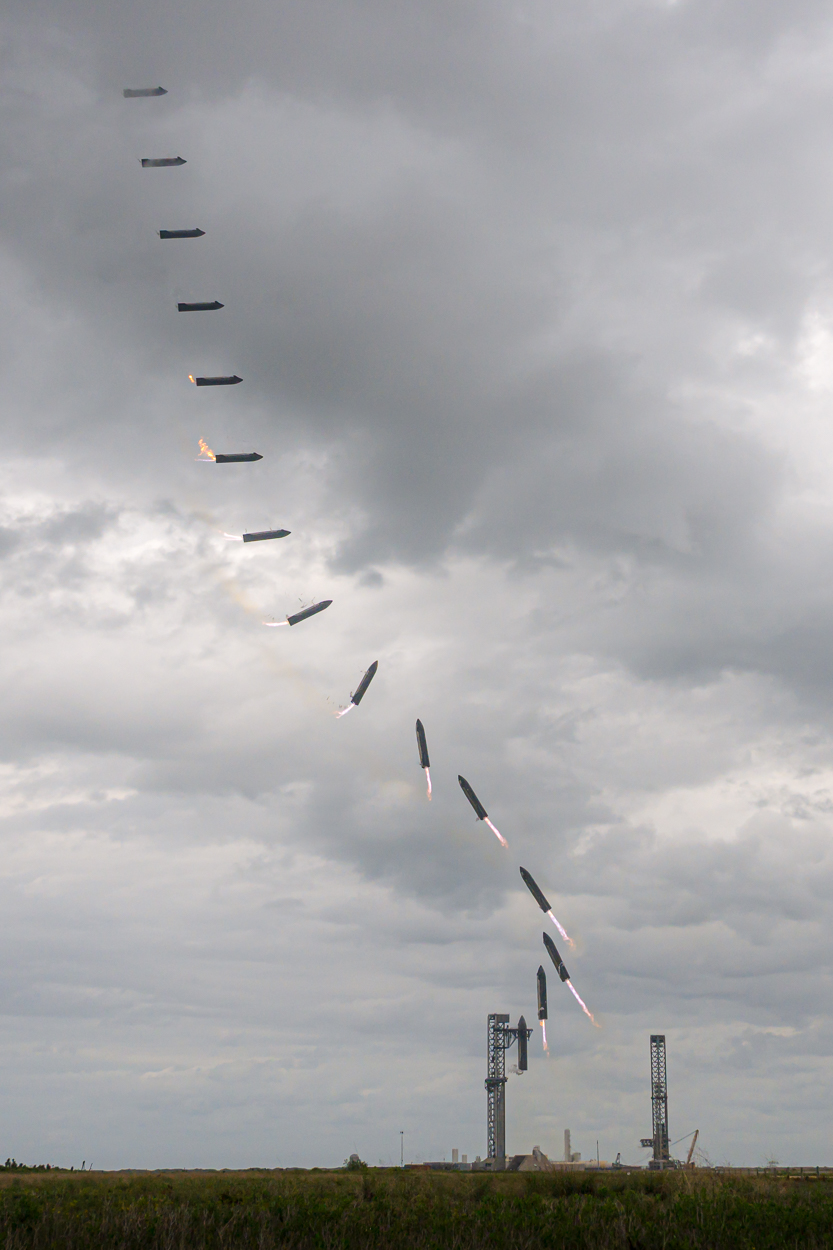
“This is actually a bigger deal for humanity than most people can imagine,” Walter Isaacson, Elon Musk’s biographer, wrote on X after SpaceX (NASDAQ: SPCX) caught its Starship spacecraft with the launch tower’s arms on Nov. 14. Musk shared the post with a message of his own: “The epic day has arrived, thanks to the incredibly talented team at SpaceX!”
Isaacson also recalled the engineers’ reactions in a Starbase conference room in December 2020, when Musk pushed the idea that the tower’s arms could catch a returning Starship.
Hours after the catch, Musk reshared his Aug. 30, 2021, post calling the tower arms “robot chopsticks,” which warned that “success is not guaranteed, but excitement is!” On Flight 15, he got half of each. The rocket’s Super Heavy booster, which was supposed to be caught the same way, was diverted and exploded in the Gulf of Mexico. SpaceX has caught three earlier versions of the booster, the first in October 2024, but this was the first attempt with its newest design.
SpaceX shares closed at $139.11 on Nov. 13, about 3% above the $135 IPO price, then slipped about 2% in after-hours trading as the booster was lost. Nov. 16 is the market’s first chance to react to the catch. The next test comes Dec. 8, when the last batch of insider shares from the IPO lockup can be sold.
Ship 42 kept climbing into orbit, which Starship first reached on the previous flight, on Sept. 28. About 35 minutes after liftoff, it began releasing 26 Starlink V3 satellites, a batch SpaceX says adds roughly 10 times the downlink capacity of a Falcon 9 Starlink launch. Three of the satellites carried cameras to photograph the ship’s heat shield, which SpaceX checked before committing to bring it home. The ship then circled Earth about 14 times.
John Krauss, Special Communications Assistant to the Administrator at NASA
Musk and SpaceX engineers were inspecting the ship within hours. “I hugged ship 42 upon its return,” he posted, along with videos showing it “looks great!”
The ship’s condition matters because SpaceX wants to fly it again. A reusable rocket is supposed to make launches far cheaper, and cheaper launches mean more Starlink satellites. SpaceX told CNN it aims to reliably reuse Starship by NASA’s Artemis IV moon mission, slated for 2028, though NASA hasn’t decided whether Starship or Blue Origin’s Blue Moon will land that crew.
In the third quarter, SpaceX reported revenue of $14.58 billion, up 161% from a year earlier and well above the $12.72 billion analysts expected. Net income was $4.4 billion, helped by about $1 billion of other income and a $390 million tax benefit. Income from operations was $2.8 billion.
Its AI business, which the company calls “Super Intelligence,” brought in $7.56 billion, topping the $5.25 billion from Connectivity, the segment that includes Starlink, for the first time. The Space segment, home to Starship, lost $7 million as research spending on the rocket rose.
Starlink had 13.6 million consumer subscribers at Sept. 30. Average monthly revenue per user rose to $69 from $66 in the second quarter but was still below $83 a year earlier. SpaceX is also pushing Starlink into the phone business.
Cheap launches matter to the stock because SpaceX is its own biggest customer. Of the 476 metric tons it put in orbit last quarter, 358 were its own payloads.
Demis Hassabis, CEO of Google DeepMind, called the catch one of the coolest things he’d ever seen and wrote that “the whole stack is now proven out,” though the booster didn’t make it back on this flight. Musk replied, “Great day.” Google’s parent company has a lot riding on SpaceX. Alphabet (NASDAQ: GOOGL) listed $75.2 billion of SpaceX shares under short-term sale restrictions in its latest quarterly report. It also blamed unrealized losses, largely from SpaceX, for a $21 billion year-over-year drop in third-quarter other income and expense.
More shares are coming — and maybe a Tesla merger
The last tranche of SpaceX’s staggered 180-day lockup ends Dec. 8. Up to 797.6 million more insider shares can be sold then, according to the IPO prospectus, because the stock missed a price test that would have released some of them in August. Musk’s own shares stay locked until June 2027.
Some big holders already own less. Founders Fund and Peter Thiel reported holding 112,948,967 fewer Class A shares at Sept. 30 than at June 30, a 26.4% drop, in a filing submitted late on Nov. 13. The filing doesn’t say whether the shares were sold, distributed to the funds’ investors or transferred. It also shows the group fell below a 5% stake, so further changes generally won’t have to be reported on that form. Quarterly 13F filings due Nov. 16 could reveal moves by other big holders.
SpaceX and Tesla (NASDAQ: TSLA) have both formed special committees of independent directors to weigh a merger, Musk said on the Oct. 20 earnings call, though calling a deal a certainty “would be overstating it.” Tesla’s latest quarterly report says there’s no assurance a deal will happen. On Nov. 12, Bloomberg reported that talks were progressing and an announcement could come as soon as December, though it could slip into early 2027. No terms have been announced. If the deal happens, Barclays analysts estimated Musk could hold about 56% of the combined company’s voting power, since his SpaceX shares carry extra votes.
The content provided on Moneywise is information to help users become financially literate. It is neither investment, tax nor legal advice, is not intended to be relied upon as a forecast, research or investment advice, and is not a recommendation, offer or solicitation to buy or sell any securities, enter into any loan, mortgage or insurance agreements or to adopt any investment strategy. Tax, investment and all other decisions should be made, as appropriate, only with guidance from a qualified professional. We make no representation or warranty of any kind, either express or implied, with respect to the data provided, the timeliness thereof, the results to be obtained by the use thereof or any other matter. Advertisers are not responsible for the content of this site, including any editorials or reviews that may appear on this site. For complete and current information on any advertiser product, please visit their website.
†Terms and Conditions apply.
You’re in.
Welcome to Moneywise! Keep an eye on your inbox for your first newsletter, free Warren Buffett investing guide, and full commenting access. Welcome to Moneywise! Keep an eye on your inbox for your first newsletter, free Warren Buffett investing guide, and full commenting access.
Money news that matters. Free in your inbox.
Join 250,000+ readers getting the money news that matters. Our free newsletter cuts through the noise. Plus get a free Warren Buffett investing guide.