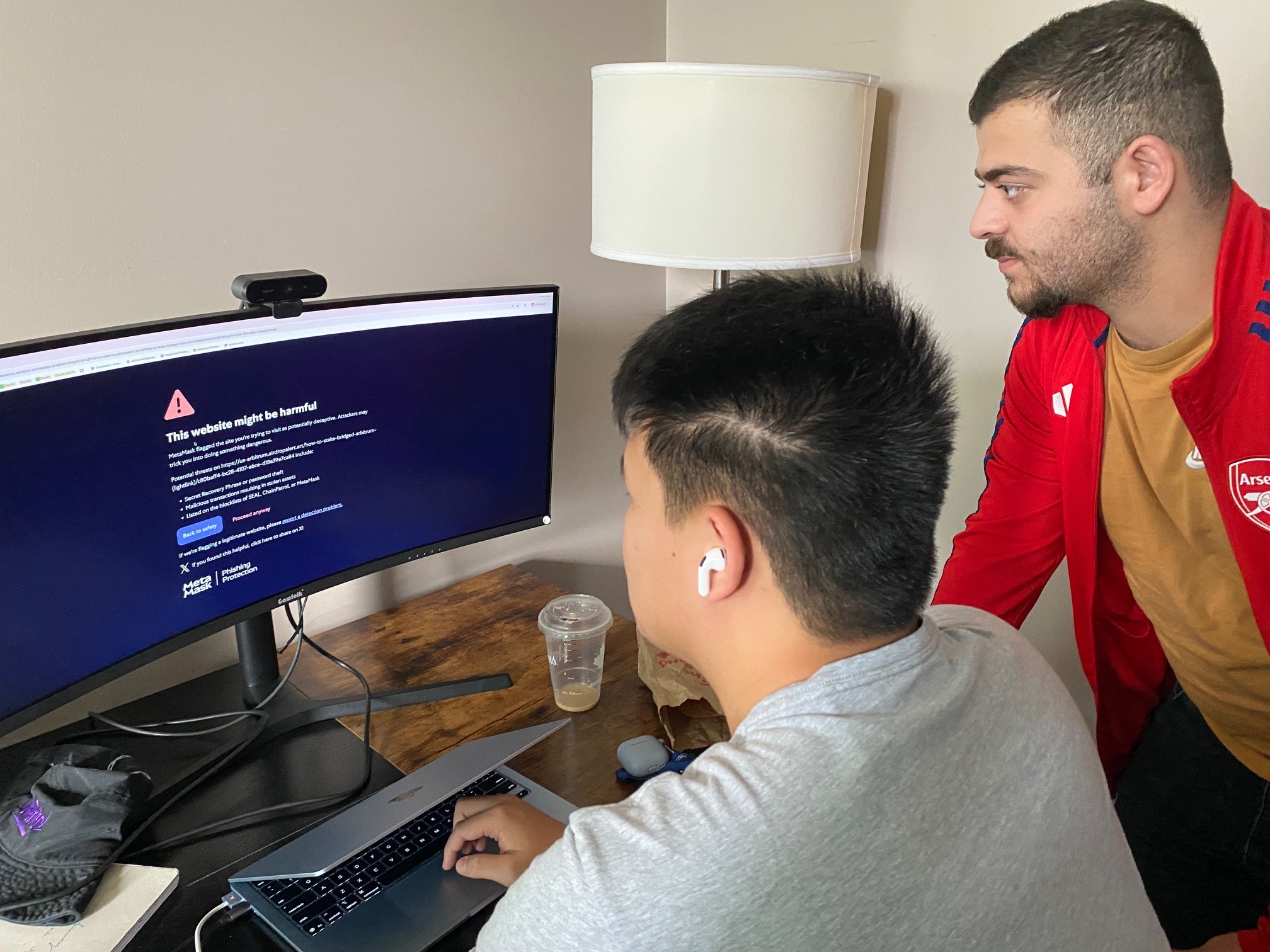
In a dim room in downtown Toronto, a group of 20-somethings huddle in front of computers, running code to spot vulnerable websites and then disrupt them. Hackers? Definitely.
But they’re not looking to steal your money or personal information. Instead, they’re fighting scammers in an arms race involving AI, cryptocurrency and organized crime. They work for ChainPatrol, a start-up that takes down scam sites impersonating legitimate cryptocurrency brands.
Nikita Varabei once worked at one of those brands, then founded ChainPatrol with his friends Umar Ahmed and Vito Giovannetti. They recognized a need for the service amid confusion surrounding digital currencies like Bitcoin and the newness of crypto technology.
“It’s a little bit of the Wild West,” he told Moneywise. “It doesn’t mean we shouldn’t settle the Wild West. But when you’re on that frontier, there’s bandits and highwaymen and robbers.”
“And snake-oil salesman,” Ahmed added.
Varabei and his teammates are among the hired guns patrolling the frontier, employed by Coinbase, Polymarket, Moonpay and other big brands to track down charlatans, according to their website.
“These companies want to get rid of scammers,” he said. “They’re under attack.”
Varabei wants to stop fraudsters in their digital tracks not only to prevent victim losses, but to restore trust in crypto, which he believes is a truly transformative and empowering technology.
Moneywise talked to Varabei and Ahmed about just what they’re up against.
A David vs. Goliath challenge
Every day, the team must scan the one to two million new websites that launch around the world, filter them down to 500,000 that may be relevant to their clients, and then identify fake ones. It’s a daunting task.
Just two years ago, it would take a criminal up to a week to create an impostor site based on a real brand like Coinbase, PayPal or Booking.com. But impostor sites were flawed, with easy tells like poor spelling and grammar, imperfect images and amateur logos.
Now, thanks to AI, hucksters can do the same job within minutes, producing not just one but multiple clones with different web addresses. Take one down, another goes up. And the sites look more and more professional — evading detection by security researchers.
“We have to be constantly innovating and adapting, just like the scammers,” Varabei said.
The biggest challenge is the scale of the crime syndicates involved. These crime rings operate throughout Asia, the Americas, Africa and Europe. They operate as big businesses and employ thousands of workers to carry out scams 24/7.
How does a small group of software engineers take on such a daunting challenge? They fight fire with fire, leveraging both AI and human intelligence. Their team of 10 in Toronto is bolstered by analysts employed in every time zone who work on investigations around the clock. Ahmed noted that their international colleagues bring both cultural awareness and language skills to the job to identify scams in multiple locations.
Advertisement
When they identify a fake site, they contact platforms around the world to load threat warnings every time someone opens a link to it. That’s a process called blocklisting, and they can make it happen in as little as 15 minutes to immediately reduce the risk.
Laura Boast/Moneywise
Ahmed said time is of the essence. Once someone loses money to a cryptocurrency scam, it’s almost impossible to identify the thief or get the funds back. “There’s no undo button for it,” he said.
Once they identify the imposters, they work with search engines, social media apps and web hosts to take them down. That takes longer, because the platforms must be sure they aren’t taking down legitimate sites. The team needs rock-solid evidence.
“Figuring out the right evidence is an art in and of itself, something that we’ve spent years developing and continue to upgrade,” he told Moneywise.
Thanks to the trust the company has built with platforms, ChainPatrol can trigger takedowns in as little as 24 hours, compared to the weeks or months it takes others. Every week they take down tens to thousands of sites.
But the problem continues. Everyone has to be vigilant, including everyday consumers like you.
While cryptocurrency and AI are still part of the digital frontier, the scams the team sees follow familiar playbooks. Here are three of the most common.
Support scams
This is a common scam in which criminals send out a message that they represent an institution — in this case a cryptocurrency company — reporting an issue with the recipient’s account, complete with a link or phone number to call for support. If the victim is hooked, scammers ask them to share their account details.
Recovery scams
These cruel scams target people who have already fallen victim to a cryptocurrency scam. Criminals send texts or emails to victims, promising to return their money for a fee. Of course, the fraudsters have no intention of returning the money, and just steal more in the process. Nikita said criminals watch for victims who post on social media about the scams they fell for.
Fake recruiter scam
Umar said anyone can fall for scams, including experts and professionals. That includes software engineers — many of whom are dealing with a tough job market in the face of AI. Criminals impersonate recruiters with LinkedIn and other organizations, approaching coders with offers to work at high-profile cryptocurrency brands. There may be an interview offer with a website link that takes the would-be job applicant to a fake Zoom link. Then the criminals install a virus on the victim’s device.
Laura Boast/Moneywise
Four ways to protect yourself
Here’s some advice from ChainPatrol on how to stay alert.
Don’t trust, verify
Question unusual requests via email, chat or text — especially involving your account security, requests for personal information or financial transactions. Don’t click links in messages. Open a browser on a separate device, log into your official account, and check your security settings.
Don’t go through it alone
Scam victims often don’t come forward out of embarrassment or fear of punishment, leaving them at even greater risk. If you suspect you’re a scam victim, confide in a trusted friend or colleague and report it to authorities.
Harden your security
The best offense is a good defense. Make sure your digital valuables are harder to steal by using a reputable password manager and strong, unique passwords. Using Multi-Factor Authentication (MFA) options like authenticator apps and hardware tokens. Avoid SMS-based MFA because it is vulnerable to SIM swapping attacks.
Reduce your online footprint
Audit your social media accounts and messaging apps for privacy and security permissions. Does everyone need to see your phone number when they search your name? Do you need to post about your stock market gains or purchases? Each one is a signal to would-be scammers that they should pay attention to you.
Laura Boast is a Senior Reporter with Moneywise.com and a lifelong content creator who has reached international audiences at Discovery, CBC, Blue Ant Media, Bond Brand Loyalty and more.
The content provided on Moneywise is information to help users become financially literate. It is neither investment, tax nor legal advice, is not intended to be relied upon as a forecast, research or investment advice, and is not a recommendation, offer or solicitation to buy or sell any securities, enter into any loan, mortgage or insurance agreements or to adopt any investment strategy. Tax, investment and all other decisions should be made, as appropriate, only with guidance from a qualified professional. We make no representation or warranty of any kind, either express or implied, with respect to the data provided, the timeliness thereof, the results to be obtained by the use thereof or any other matter. Advertisers are not responsible for the content of this site, including any editorials or reviews that may appear on this site. For complete and current information on any advertiser product, please visit their website.
†Terms and Conditions apply.
You’re in.
Welcome to Moneywise! Keep an eye on your inbox for your first newsletter, free Warren Buffett investing guide, and full commenting access. Welcome to Moneywise! Keep an eye on your inbox for your first newsletter, free Warren Buffett investing guide, and full commenting access.
Money news that matters. Free in your inbox.
Join 250,000+ readers getting the money news that matters. Our free newsletter cuts through the noise. Plus get a free Warren Buffett investing guide.