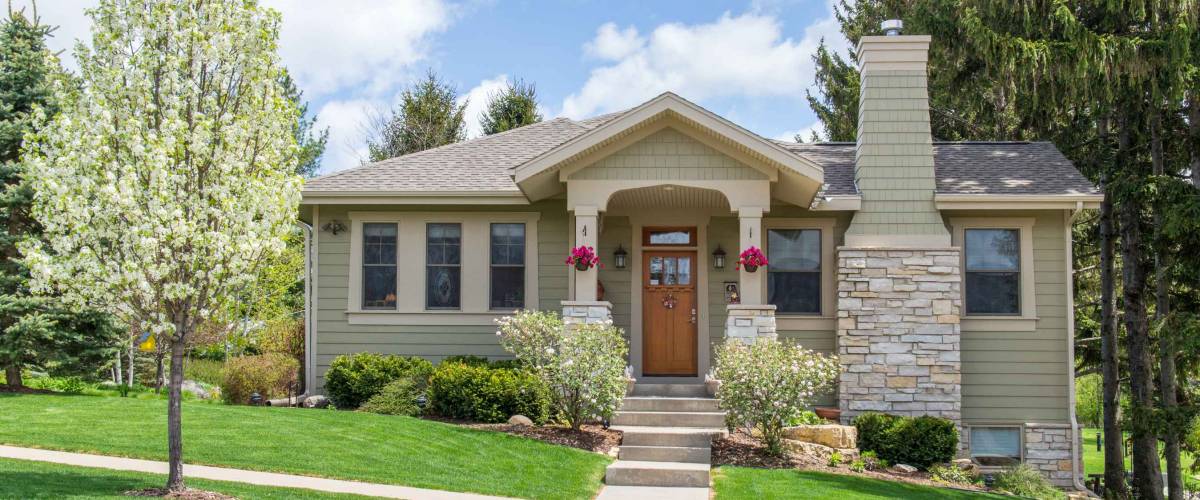
Bungalows have been a popular style of home in the United States since the beginning of the 20th century, and with good reason — they’re simple, stylish, and give hardworking families the chance to live out the American dream.
But what exactly is a bungalow? For most people, the first thing that comes to mind is a small one-story house.
However, bungalows come in a wide variety of architectural styles and layouts: Craftsman bungalows, California bungalows, Chicago bungalows — it can be hard to keep track of them all if you’re not an expert.
At the most basic level, a bungalow is a one- or one-and-a-half-story single-family home.
But the term bungalow has been adopted by a growing number of designs over the years, and the definition has become more flexible.
If you’re not sure whether a home is a bungalow, here are some of the hallmark features to look out for.
1. Low profile on a high foundation
Bungalows feature a long, low profile and a high foundation, which typically requires front steps for entry. The original purpose of this design choice was to fit all of the living space in the house on the main floor, which simplifies the building process and makes it easier to install utilities.
2. Low-pitched roof
A low-pitched roof is another standard characteristic of bungalows, and helps contribute to the low profile mentioned above. The roof on a bungalow can be gabled or hipped, and usually features deep eaves. Many bungalow roofs also have exposed rafters, which are mainly for decorative purposes.
3. Open floor plan
Moving inside, a defining interior characteristic of a bungalow is an open floor plan. The front door typically opens up into the main living room, and most bungalows do not contain a formal parlor or sitting room.
4. Built-in design elements
Bungalows often feature built-ins like cabinetry as decorative accents. Many bungalow homes also contain a sizable fireplace flanked by these built-in elements — usually shelves or bookcases.
5. A large front porch
One of the most attractive and recognizable features of most bungalow types is a large front porch. The big porch provides more living space to help offset the bungalow’s limited square footage, and extends the open floor plan of the home into the outdoors.
Suzanne Tucker / Shutterstock A Craftsman bungalow.
Bungalows can look different depending on the part of the country you’re in.
The Craftsman bungalow is what most people think of when they picture a classic bungalow. Craftsman bungalows are sometimes referred to as Arts and Crafts bungalows, after the movement in the late 1800s and early 1900s led by designers like Gustav Stickley. They usually have a covered front porch and wide overhanging eaves.
Chicago bungalows, which make up almost a third of the city’s single-family houses, typically have a brick exterior and feature an offset front entrance and gables that face the street.
California bungalows typically have exteriors made of wood (particularly redwood), stucco, shingle or horizontal siding.
Milwaukee bungalows tend to have rounded doorways and white stucco on the lower portion of their exteriors.
Tudor Revival bungalows, inspired by British architecture of the late 1400s, typically feature wall-cladding, narrow windows and half-timbering around the exterior. They’re also noteworthy for their steeply pitched roofs, which often include dormers, clipped gables and an elaborate chimney.
Prairie-style bungalows fall under the Prairie School of design, developed by Chicago-based architects including Frank Lloyd Wright. These homes typically feature large piers that support their porch roofs, flat or shallow roof lines, rows of casement windows and bands of stone, wood or brick across the surface of the home.
Who is a bungalow home good for?
Although bungalows may not be as spacious as some other types of homes, their compact size does come with several advantages.
Advantages of bungalow style homes
More privacy
Due to their low profile, bungalows make it easy to shield the windows from prying eyes with a few strategically placed plants or shrubs. The small footprint of a bungalow also provides more space along the sides of the house compared to other housing styles, and that allows for more breathing room between neighbors.
More manageable for older occupants
Since most bungalows contain all of the living space on a single floor, they’re an ideal option for older occupants who may have mobility issues. There are few (if any) stairs to navigate, and private areas of the home like bedrooms and bathrooms are typically close together, making for easy access.
Great for kids
As with older adults, children can often have trouble navigating stairs. The single-story layout of a bungalow reduces the risk of falls, and the open floor plan lets children who are still learning to walk move around the house more freely.
Potential for expansion
Since bungalows are often situated on large lots, there can be room to expand if more space is required. As your family grows, you can add on additional bedrooms or living areas to accommodate your needs.
Excellent resale value
Because they’re small and efficient, bungalows are always in high demand: They’re perfect for new families buying their first starter home, as well as older couples who have decided to downsize.
Disadvantages of a bungalow
As with most things in life, bungalows have a few disadvantages, too.
They can be hard to buy
Thanks to their steady popularity, finding a bungalow for a decent price can sometimes be tricky. Since they’re in such high demand, bungalows often get snatched up as soon as they hit the market. In order to lock one down, you might need to make an offer that’s higher than the asking price.
More expensive per square foot
Another disadvantage of bungalows is that they tend to have a higher cost per square foot than a small two-story home. Since all of the rooms are usually located on one floor, the footprint of a bungalow tends to be bigger. A larger footprint requires the home’s roofing materials to cover more real estate, which can be costly when the time comes to repair or replace the roof.
They can feel cramped
As your family grows, the compact size of a bungalow can sometimes be a challenge. Since all of the bedrooms are usually close together — and close to the bathroom — noise can become an issue as the number of inhabitants increases, particularly for anyone who’s a light sleeper.
Security issues
Although the low-profile of a bungalow is commonly seen as an advantage, for residents concerned about security issues it may be less of a pro and more of a con. Some people can feel nervous about having a bedroom at street level, especially if they’re inclined to sleep with the window open.
Shane is a reporter for Moneywise. He holds a bachelor’s degree in English Language & Literature from Western University and is a graduate of the Algonquin College Scriptwriting program.
The content provided on Moneywise is information to help users become financially literate. It is neither investment, tax nor legal advice, is not intended to be relied upon as a forecast, research or investment advice, and is not a recommendation, offer or solicitation to buy or sell any securities, enter into any loan, mortgage or insurance agreements or to adopt any investment strategy. Tax, investment and all other decisions should be made, as appropriate, only with guidance from a qualified professional. We make no representation or warranty of any kind, either express or implied, with respect to the data provided, the timeliness thereof, the results to be obtained by the use thereof or any other matter. Advertisers are not responsible for the content of this site, including any editorials or reviews that may appear on this site. For complete and current information on any advertiser product, please visit their website.
†Terms and Conditions apply.
You’re in.
Welcome to Moneywise! Keep an eye on your inbox for your first newsletter, free Warren Buffett investing guide, and full commenting access. Welcome to Moneywise! Keep an eye on your inbox for your first newsletter, free Warren Buffett investing guide, and full commenting access.
Our free newsletter helps you navigate your mortgage.
Join 250,000+ readers navigating the housing market. Our free newsletter covers rates and what they mean for your mortgage. Plus get a free Buffett investing guide.