
Apr 11, 2023
While we adhere to strict editorial guidelines, partners on this page may provide us earnings.
Dealing with hunting down receipts, calculating deductions, keeping track of tax forms that all look the same, wondering if you’re paying more than you should — it's no surprise most of us dread tax season.
That said, while tax time can be confusing, it’s also an opportunity.
Advertisement
If you learn how to file taxes on your own, it’ll force you to face your finances head-on, take ownership and play a more active role in your financial plan. Let's get started.
More: How much of your paycheck goes to taxes?
1. Preparing to do your own taxes
The key to a painless DIY tax-time experience is proper preparation. Getting organized and creating a game plan is half the battle and will make the rest of the process go more smoothly.
Get necessary documents in order
The tax documents you need will depend on your unique financial situation. Here are some of the most common:
-
W-2s - You should receive a W-2 from each of your employers. Your W-2 will tell you how much your annual wages and how much tax was withheld. If you earned money from more than one employer, you will receive multiple W-2 forms that need to be added together.
-
1099s - You may receive 1099s for other forms of income. There are over 15 different types of 1099 forms (which can get confusing), but the most common is Form 1099-MISC, which you’ll receive from any freelance or contract client who paid you over $600. Other common 1099s are Form 1099-DIV and 1099-INT, which show how much dividends and interest earned on your investments.
-
Interest statements - The interest you pay on student loans and mortgages may be tax-deductible. If you’ve made student loan interest payments, you’ll receive a 1098-E. If you’ve paid interest on a mortgage, you should receive a mortgage interest statement from your lender.
For any deduction you take, you’ll need to be able to prove it with a receipt. For example, if you’re self-employed, you’ll need receipts for business-related expenses like meals, advertising, travel expenses, education, etc. If you’ve made charitable contributions or had significant unreimbursed medical expenses (greater than 7.5% of your adjusted gross income), you’ll want to gather those receipts as well.
You'll also need proof of contributions to health savings accounts (HSAs) and certain retirement accounts, including 401(k)s, IRAs and 403(b)s. That money is tax-deductible and may even qualify you for a saver’s credit.
Must Read
- Dave Ramsey warns nearly 50% of Americans are making 1 big Social Security mistake — are you doing the same?
- Thanks to Jeff Bezos, you can now become a landlord for as little as $100 — and no, you don't have to deal with tenants or fix freezers. Here's how
- Robert Kiyosaki says this 1 asset will surge 400% in a year and begs investors not to miss this ‘explosion’
Join 250,000+ readers and get Moneywise’s best stories and exclusive interviews first — clear insights curated and delivered weekly. Subscribe now.
2. Know your filing status
The filing status you choose could significantly affect your tax bill.
In many cases, choosing the correct status is straightforward. But as you’re about to see, it can also get complicated.
Here are the filing statuses you’ll choose from:

Advertisement
-
Single - If you’ve never been married, or you are divorced or legally separated
-
Married filing jointly - You may choose this status if you were married before December 31 of the tax year in question. Filing jointly makes sense for most married couples due to added tax breaks.
-
Married filing separately - This is where things get confusing. If you’re married, you and your spouse also have the option to file separately. But why would you do that? Two possible reasons: You realize that filing separately lowers your tax burden (that is, if one spouse has significant unreimbursed medical expenses, which can be deducted only after they exceed 7.5% of your adjusted gross income); You and your spouse keep your finances separate. To determine which filing status will result in the fewest taxes owed, you’ll have to run the numbers both ways — filing jointly and filing separately.
-
Head of household - If you are unmarried with dependents living with you, filing as head of household will give you more tax advantages than filing as Single.
-
Widow or widower with dependents - If you have dependent children or other family members and your spouse has died.
3. Select the right form(s)
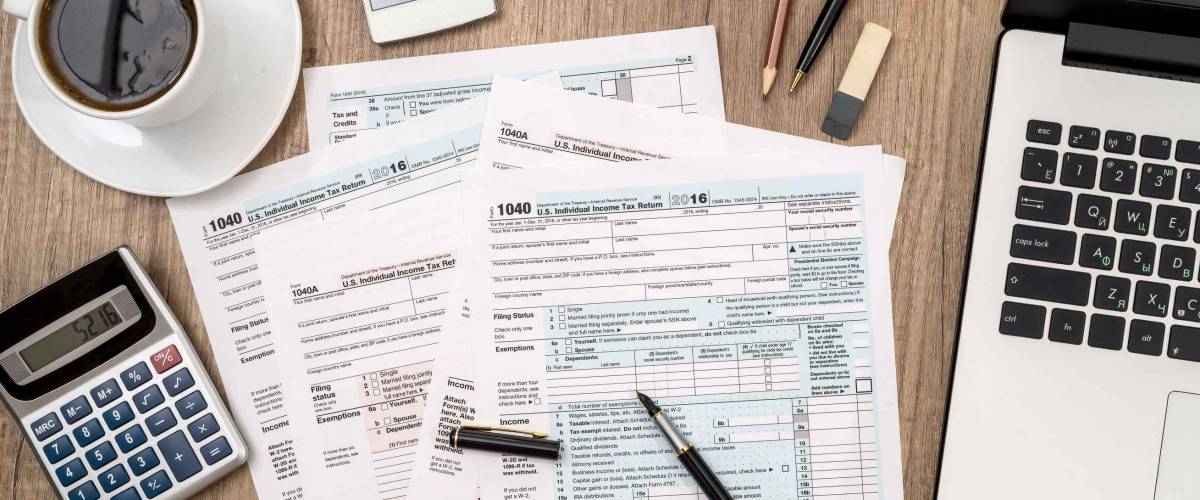
In the past, taxpayers had to choose between three confusingly similar forms: Form 1040, Form 1040-A, and Form 1040-EZ.
Then in 2018, these forms were all merged into the “new” Form 1040.
If you fill out Form 1040, you did it right. That said, there are a few other forms to be aware of:
-
Form 1040-SR - New simplified tax form for taxpayers age 65 or older who have uncomplicated financial situations
-
Form 1040-ES - Used to calculate and pay estimated tax on income for the current year that is not subject to withholding. This includes self-employment income, rental property income, interests, dividends, etc.
-
Schedule A - Form needed if you decide to itemize your tax deductions.
Read More: Dave Ramsey says this 7-step plan ‘works every single time’ to kill debt, get rich in America — and that ‘anyone’ can do it
4. Determine your tax deductions
One of the biggest advantages to hiring a professional tax preparer is that they will know all the tax breaks you qualify for.
But don't fret if you are doing your own taxes; you'll just want to plan time to do some research so that you don't overpay. Some of the most common tax credits and deductions are:
- Child tax credit
- Charitable donations credit
- Medical expenses deduction
- Student loan interest deduction
- Child and dependent care tax credit
- Self-employment expenses deduction
- Lifetime learning credit (for tuition costs)
- Earned income credit (for low income-earners)
- Retirement plan or health savings account contribution deductions
Many of these deductions involve some gray area, especially when it comes to self-employment expenses. To avoid mishaps with the IRS, try not to push the limits too far with questionable deductions.
5. Will you itemize or use the standard deduction?
After you add up all your eligible deductions, you’ll have a decision to make.
Advertisement
For the 2022 tax year, the standard deduction is $12,950 for single taxpayers and married individuals filing separately ($25,900 if you are married and filing jointly). If this is less than the sum of your itemized deductions, you can lower your tax burden by itemizing.
That said, if you itemize deductions, you’ll need to gather proof for each individual deduction and fill out extra paperwork. This extra time and complexity might not be worth it if your itemized deductions aren’t significantly greater than the standard deduction.
6. When to file your own taxes
**The deadline to file taxes this year is April 18, 2022. **
To figure out when to file your own taxes, your best bet is to schedule a “tax prep day” as early as possible. This will leave you wiggle room in case you need extra time to hunt down any missing documents.
If for some reason you know you can’t finish by the tax due date, you can file for an extension. Keep in mind, you’ll still need to pay your estimated taxes by the normal deadline.
7. How to do your own taxes
Before diving into your taxes, make sure to check for any important tax changes for the current tax season. Laws are constantly changing, and the rules you followed in the past may have changed.
Once you’re up to date, you’ll have to decide whether you’ll file your taxes by hand, online at the IRS e-File website, or by using tax-filing software.
By hand
If you’re not comfortable using technology or just like to do things the old-fashioned way, you can download your forms from the IRS website, print them out, and complete them by hand. Apart from the stamp needed to mail in your returns, this option is completely free.
Printing out paper forms only makes sense if you have a simple tax situation. If not, it can get overwhelming shuffling through stacks of paperwork, filling up scratch paper with calculations, and praying you don’t accidentally fill in the wrong box.
IRS e-File
Another free option is to use the free fillable forms on the IRS e-File website. This method helps you stay organized, and since the forms make basic calculations automatically, you lessen the risk of math errors.
Advertisement
These forms have line-by-line instructions to help you fill them out, but it doesn’t show you which forms to choose or offer personalized tax advice — that is research you’ll have to do yourself.
Whether you fill out forms by hand or online, the IRS Interactive Tax Assistant (ITA) is a handy resource that covers many common questions you may have.
Tax software
If you have a more complex tax situation or just don't want to do things by hand, there are a number of tax software options to choose from:
The price of these tools ranges from free to a few hundred dollars depending on the complexity of your finances. If you have a simple tax situation, filing your federal return may even be free.
Unlike the IRS fillable forms, these sites will help you find potential deductions that maximize your refund.
Tax software is designed to make the filing process as foolproof as possible — starting from the moment you land on their homepage.
More: Anime dating simulator marries romance and tax prep
You May Also Like
- Turning 50 with $0 saved for retirement? Most people don’t realize they’re actually just entering their prime earning decade. Here are 6 ways to catch up fast
- Inside a $1B real estate fund offering access to thousands of income-producing rental properties — with flexible minimums starting at $10
- Vanguard’s outlook on U.S. stocks is raising alarm bells for retirees. Here’s why and how to protect yourself
- Here are 5 easy ways to own multiple properties like Bezos and Beyoncé. You can start with $10 (and no, you don’t have to manage a single thing)

Mitchell is a freelance contributor to Moneywise.com.

Loans • Feb 17
Personal loans vs. credit cards: Which one is better?

Mortgages • Mar 19