

Advertisement
Advertisement
Turns out many well-known American brands are no longer American-owned.
When you spend your hard-earned dollars hoping to support the good ol’ US of A, you might actually be lining the pockets of a giant conglomerate based in another country.
To help you figure out who owns what, here’s a list of 25 “American” companies that are now under foreign control.
Advertisement
1. Budweiser

There’s nothing more American than sipping a crisp Budweiser beer, right? Well, not anymore.
While Budweiser is still portrayed as the beer of the Yankees, it’s actually owned by Belgian beer conglomerate Anheuser-Busch InBev, a company that also owns the brands Corona, Stella Artois, Hoegaarden, Beck’s, Goose Island and Leffe.
Advertisement
The Busch family had to part ways with Budweiser in 2008 in a $52 billion sale. Many Busch family members resisted selling, but since the family owned only 5 percent of shares at the time, they had no choice — especially since Warren Buffett, one of Anheuser-Busch's top shareholders, supported the InBev takeover.
Advertisement
2. Burger King

Home of the Whopper, Burger King originally started as “Insta-Burger King” in Jacksonville, Fla., in the 1950s. The brand has changed hands several times since then.
In 2010, private equity firm 3G Capital purchased BK for $3.26 billion. And in 2014, a $12.5 billion merger combined BK with Tim Hortons to form the Canadian fast-food company Restaurant Brands International.
3G Capital is still pulling the strings, attempting to grow the world’s leading restaurant brand. They have since added Popeyes to their portfolio and enjoy tax savings since the move across the border to Canada.
Advertisement
3. American Apparel

Despite its (now slightly misleading) name, American Apparel is not an American brand. Famous for its “Made in the USA” slogan, the retailer once claimed to be the largest clothing manufacturer in the U.S.
Times have changed.
In 2017, the Canadian clothing company Gildan Activewear purchased American Apparel for $88 million, two years after it filed for bankruptcy.
Since then, the “Made in USA” tags have disappeared from the inside of garments, and now the company uses the slogan “Ethically Made — Sweatshop Free.”
Advertisement
4. Holiday Inn

Holiday Inn was born in 1952 in Memphis, Tenn., after Kemmons Wilson, the founder, struggled to find an affordable place to stay while on vacation.
Soon after, the midscale hotel brand won a reputation for its balance of comfort and value. But in the late 1980s, demographic shifts and changes in the competitive arena led the company to start losing market dominance and they decided to sell.
In a complex transaction lasting from 1988 to 1990, Bass PLC, the makers of Bass beer, took over. They later sold the beer company and formed the InterContinental Hotels Group (IHG), the British company that now owns Holiday Inn.
Advertisement
5. Trader Joe’s

Ever since the first store opened in California in 1967, Trader Joe’s has been known for its high quality and hard-to-find brands.
The original Trader Joe, Joe Coulombe, purposely stocked discontinued products in order to compete with the dominant 7-Eleven.
In 1979, Theo Albrecht, the owner of the German supermarket brand Aldi Nord, bought out Trader Joe’s, but the tradition of unique, high-quality products continued.
Advertisement
6. Ben & Jerry’s

Ben & Jerry’s ice cream is as American as it gets. Or at least, it used to be.
After taking a $5 ice-cream-making course, two BFFs, Ben Cohen and Jerry Greenfield, started a humble ice cream parlor in 1978.
It must have been a good course, because the quality ice cream, heavy mix-ins and clever flavor names were a hit.
The brand exploded and enjoyed decades of success. But in the late 1990s, stock prices started to slip. After refusing offers to sell out to Dreyer’s Grand Ice Cream, they finally caved and sold to the Dutch-British consumer goods company Unilever for $325 million in 2000.
Advertisement
7. AMC Theatres

If you think you’re supporting the U.S. by catching a flick at AMC (American Multi-Cinema) Theatres, you’d be wrong.
In 2012, Dalian Wanda — a Chinese conglomerate run by real estate tycoon and billionaire Wang Jianlin — took over AMC for $2.6 billion.
Advertisement
Dalian Wanda was the majority shareholder for almost 10 years. But in 2021, when AMC stock prices skyrocketed around the time of the Reddit GameStop incident, Wanda sold the majority of its shares.
According to Yahoo, AMC now has about 3 million individual shareholders, and none of them owns more than 10 percent of the company.
Advertisement
8. Hoover

At its peak, Hoover was the Kleenex of vacuum cleaners in America.
Originally called the “suction sweeper,” the Hoover vacuum was born in 1907 when an allergy-ridden janitor got fed up sweeping dust into the air. Since its humble beginnings, Hoover has expanded into a leading multinational floor-care company.
Hoover has had multiple owners over the past century. In 2007, the company changed hands from Whirlpool Corp. to Hong Kong-based Techtronic Industries for $108 million.
At the time, Hoover was struggling due to high costs and lagging innovation. It also fit nicely into Techtronic’s’ vacuum brand portfolio — which includes Dirt Devil and Regina — and allowed Whirlpool to refocus on its main offering, home appliances.
Advertisement
9. Forbes

Forbes is one of the most-read business publications in the U.S., but it’s no longer entirely American-owned.
After almost 100 years of operating independently, Forbes was taken over in 2014 by Hong Kong’s Integrated Whale Media Investments. The exact sale price was not disclosed, but Forbes was valued at $475 million at the time.
Although Forbes has grown since the Hong Kong company took over, several of its contributors say its China-related content has become biased and censored, according to the Washington Post.
Advertisement
10. Hellmann’s

Hellmann’s mayonnaise — also known as Best Foods in some parts of the country — is the best-selling mayonnaise in the United States. The company started in New York City in 1905 and stayed on American soil for 95 years.
In 2000, Unilever, the same Dutch-British company that acquired Ben & Jerry’s ice cream, snatched up Hellmann’s for $20.3 billion.
Today, the famous mayonnaise is still sold under two separate brand names — Hellmann’s east of the Rockies, and Best Foods to the west.
Advertisement
11. Dirt Devil

Dirt Devil is another famous American-bred vacuum company that has been around for more than a century.
The brand is now synonymous with “vacuum cleaner,” and the company’s hand-held model was once the top-selling such model in the U.S.
Advertisement
But in 2002, Dirt Devil moved to Hong Kong. Techtronic Industries, the same company that later bought out Hoover, started its vacuum-cleaner-company-acquiring rampage by purchasing Dirt Devil for $105.5 million.
According to PR Newswire, after buying these vacuum companies, Techtronic became the largest floor care business in North America.
Advertisement
12. GE appliances

General Electric (GE) has been supplying America with home appliances since the late 1800s. From the first patented electric fan to refrigerators, irons, sewing machines and more, GE is an appliance brand widely trusted by Americans.
But most Americans don’t realize that GE’s appliance business was sold to a Chinese-run company.
As time passed and electricity evolved, so did GE. The company grew into more than just an appliance brand and started branching into software applications.
Due to this shift in focus, it sold the appliance business to Haier, a Chinese company, for $5.4 billion in a deal that was finalized in 2016. GE Chairman and CEO Jeff Immelt explained that saying goodbye to the appliances division would allow them to be a more competitive company in the digital-industrial space.
Advertisement
13. Firestone

Firestone is a (formerly) American tire company that has been supplying Americans with car tires since 1901. Harvey Firestone, the company’s founder, was even a buddy of Henry Ford and produced tires for the Model T.
But in 1988, Firestone moved overseas. To prevent an unsolicited takeover by the Italian tire company Pirelli, Firestone agreed to a $2.6 billion acquisition by Tokyo’s Bridgestone Corp.
This purchase made Bridgestone the second-largest tire manufacturer in the United States. Today, Bridgestone is the largest tire manufacturer worldwide.
Advertisement
14. Gerber

Gerber baby food began in 1927 in the small town of Fremont, Mich., when Dorothy Gerber’s pediatrician recommended that she strain solid foods for her baby. The Gerbers already ran a canning business, and they quickly saw the business opportunity.
Since then, Gerber has grown to dominate the baby food market in the United States.
In 1994, Gerber combined forces with Swiss-owned Sandoz Ltd. to expand the brand internationally. Later, in 2007, Nestlé, another Swiss company, took over in a $5.5 billion acquisition.
Advertisement
15. Waldorf Astoria

Originally built in 1893, then rebuilt in 1931, the Waldorf Astoria is an iconic hotel that takes up an entire city block in Manhattan. In those days, it was the largest hotel in the world.
Today, parts of it are considered official New York City landmarks. Yet the hotel itself is Chinese-owned.
In 2014, the Chinese company Anbang Insurance Group purchased it for $1.95 billion, making it the most expensive hotel sale in history at the time.
In 2018, the Chinese government seized control of the hotel for a year. So much for an American historical landmark.
Advertisement
16. IBM (PC division)

International Business Machines Corp. (IBM) got its start in the late 1800s producing tabulation equipment used in the 1890 U.S. census. For the first 30 years of business, it operated under an equally tongue-twisting name — the Computing-Tabulating-Recording Company.
As technology evolved, so did IBM. In the 1960s, when computers weighed more than adult humans, IBM was the largest computer manufacturer in America (and the world).
But as computers shrank in size and were marketed to consumers, IBM struggled to keep up. Finally, Lenovo, a Chinese company, bought its PC business for $1.25 billion in 2005.
Advertisement
17. Sunglass Hut

Sunglass Hut was launched in 1971 by an optometrist in Miami in a humble mall kiosk. Within 15 years, that small kiosk had multiplied into 100 stores across America.
In the mid-1990s, the confident company began opening more stores than it could handle. Despite a strong market presence, it spiraled into debt.
In 2001, an Italian eyewear company, Luxottica, acquired Sunglass Hut (and all its debt) for $462 million.
Luxottica Group is now the world’s leading eyewear company. Among its brands are Ray-Ban and Oakley.
Advertisement
18. Legendary Entertainment Group

Legendary Entertainment Group is a giant media company most recognizable for its knot logo that appears at the beginning of such films as Jurassic World, The Hangover and Inception.
In 2016, this American company changed hands and is now owned by China’s Dalian Wanda Group. The $3.5 billion acquisition makes Dalian Wanda, a real estate and investment conglomerate, one of the biggest international entertainment companies to date.
In addition to owning China’s largest movie theatre company, Wanda also picked up American-owned AMC Theatres in 2012. So not only does Wanda own the media company that produces big-budget flicks, but it also owns the theatres where everyone goes to watch them.
Advertisement
19. Lucky Strike

Lucky Strike was founded in 1871 in Virginia, acquired by American Tobacco Company in 1905, and became America’s leading cigarette brand in the 1930s and 1940s.
However, as new cigarette filters rolled out in the 1950s, Lucky Strikes couldn’t keep up with the competition.
Advertisement
In 1976, British American Tobacco, a former partner company from the United Kingdom, acquired American Tobacco — including the Lucky Strike brand — and it has remained under British control ever since.
Advertisement
20. Popsicle

Popsicle is so popular that the brand name now has its own dictionary definition.
Founded in California in 1924, this American brand refreshed consumers for 65 years before selling to Good Humor, which is now a subsidiary of Unilever, the Dutch-British consumer goods company.
Even though the word “popsicle” found its way into the dictionary and has essentially replaced the generic term “ice pop,” it is still a trademarked term. That means Unilever has the unfortunate duty of protecting it, and it regularly sends out trademark-infringement letters to ice pop startups like People’s Popsicles.
Advertisement
21. Motorola Mobility

Motorola, founded in Chicago in 1928, is credited with blessing America (and the world) with several inventions — the first car radio, walkie-talkie and mobile phones.
As Motorola grew, the company became more complex. To keep things simple for investors, it split into two firms in 2011: Motorola Mobility and Motorola Solutions.
Motorola Mobility, the arm focused on mobile devices such as smartphones and tablets, was taken over by China’s Lenovo for $2.9 billion in 2014.
Advertisement
22. John Hancock

The John Hancock Life Insurance Company was founded more than 150 years ago in Massachusetts. The 1850s were notorious for dishonest business dealings, so to instill trust in the brand, its creators named their new company after the Massachusetts-native founding father.
Their strategy worked, as John Hancock is the only life insurance company from that era that still exists.
But it’s no longer an American company. In 2004, the Canadian insurance company Manulife Financial Corp. acquired John Hancock for $15 billion, making it the largest Canadian cross-border transaction at the time.
Advertisement
23. Frigidaire

The year 1918 was an exciting time in Indiana — a local startup, Guardian Frigerator Company, had just released the world’s first self-contained refrigerator (just in time to keep those Popsicles cold in 1924).
Soon after, the company was acquired by General Motors and renamed Frigidaire, which later gained recognition for producing quality air conditioners, washers and dryers.
In 1979, General Motors passed Frigidaire over to Ohio-based White Sewing Machine Company, which later sold it to Electrolux, a Swedish firm.
Advertisement
24. Saks Fifth Avenue

Saks Fifth Avenue is an American luxury department store chain that was established in Manhattan nearly 100 years ago. The original store offered top-notch customer service and sold high quality clothes. It’s now considered a New York landmark.
Today, it has 40 stores across North America, and despite changing ownership several times over the past decade, the store’s luxury standards remain.
In 2013, Canada’s oldest company, the Hudson’s Bay Company, bought Saks Inc. from its parent company, Proffitt’s Inc., for $2.9 billion.
Advertisement
25. Purina

Ralston Purina, which invented the first dry food for dogs, is widely known as the company that feeds America’s furry friends.
It has been one of the top pet food brands for more than 100 years, but it no longer is American-owned. In fact, the company has crossed borders multiple times — first to British Petroleum in 1986, and later to Switzerland's Nestlé in 2001 for $10.3 billion.
This sweet deal for Ralston Purina shareholders was predicted to allow Purina to grow faster than it could on its own.
These Are the Big Brands Behind Your Favorite Trader Joe's Snacks
For a company that dresses its employees in loud Hawaiian shirts, Trader Joe’s is notoriously hush-hush about its business model.
Advertisement
Like other chains, Trader Joe’s doesn’t actually manufacture all the peanut butter cups and salad dressings that bear its name. Businesses like Costco occasionally leak the big brands that manufacture their private-label products, but it turns out TJ’s takes the term “private” very seriously.
So we did a bit of sleuthing ourselves and found enough evidence — including a number of recalls from the Food and Drug Administration (FDA) — to reveal the familiar names behind some of your favorite items at this specialty grocery store.
Here are the names we can confirm and the myths we can debunk (assuming no recent supplier swaps) so you can find the cheaper option.
Advertisement
21. Bazzini dark chocolate almond butter cups

Confirmed.
This Trader Joe’s sweet treat gets supplied by nut brand Bazzini, which has been around since 1886.
In June 2020, Bazzini recalled Trader Joe's Dark Chocolate Almond Butter Cups as they may have contained peanut protein. The label on the product did state that it “may contain traces” of peanut, but after reports of allergic reactions, the Pennsylvania-based supplier decided to pull the item off shelves.
Bazzini produces individual bags of cashews, almonds, pistachios and filberts, snack mixes, dried fruit and fruit and nut bars.
Advertisement
20. Snak King white corn tortilla chips

Confirmed.
Put away the salsa — this sna(c)k food private label manufacturer issued a recall of Trader Joe’s Restaurant Style White Corn Tortilla Chips in April 2021.
The 9-ounce chip bags may have contained an undeclared milk allergen, which could have triggered serious reactions in consumers with milk sensitivities or allergies. Luckily, no illnesses were reported.
Advertisement
Snak King’s lineup of brands includes El Sabroso, The Whole Earth, Granny Goose, Jensen’s Orchard and Nutibles, and the manufacturer produces everything from tortilla chips and popcorn to veggie-flavored crisps and straws.
Advertisement
19. Orca Bay gluten free battered halibut

Confirmed.
Something went fishy with this seafood brand’s gluten-free battered halibut in October 2020.
Seattle-based Orca Bay recalled 356 10-ounce cases of Trader Joe's Gluten Free Battered Halibut last year due to undeclared wheat and milk allergens.
Orca Bay Foods — the result of a merger between Orca Bay Seafoods and Odyssey Foods in 2019 — also sells fillets and steaks under its own brand name. It sources seafood both locally and globally and processes meal-sized, frozen portions to be sold in stores.
The company says on its website that, “Quality is numero uno” and claims you’ll get “seafood that’s on a par with stuff in the fresh case, if not even better.”
Advertisement
18. Ghiringhelli’s broccoli slaw and kale salad

Confirmed.
The USDA announced in 2016 that Vallejo-based Ghiringhelli Specialty Foods was recalling Trader Joe’s Broccoli Slaw & Kale Salad with White Chicken Meat.
The salad also includes sunflower seeds, cranberries and a sweet and spicy vinaigrette — the company’s sunflower seed vendor notified it that the product may have been contaminated with listeria.
Advertisement
Ghiringhelli mainly produces salads, wraps, pizzas and grilled chicken for private label food lines, but it first began as a pizzeria in California, Fairfax in 1985. Fairfax and Novato locals will recognize the name, as Ghiringhelli's Pizzeria is still around today.
Advertisement
17. Aliya’s Foods’ butter chicken with basmati rice

Probable.
Indian cuisine company Aliya’s Foods Limited, which owns brand Chef Bombay, is most likely responsible for this ready-made meal.
Aliya’s Foods recalled nearly 5,000 pounds of its frozen Butter Chicken with Basmati Rice product back in 2012 because of a possible listeria contamination, reports Fox News.
The company is based in Alberta, Canada and began as a small samosa plant before expanding to include other frozen, Indian-inspired dishes, like chicken tikka masala, beef vindaloo and vegetable pakoras.
Advertisement
16. Wonderful pistachios

Confirmed.
We cracked into Trader Joe’s store-brand pistachios and found they’re supplied by The Wonderful Company.
A salmonella outbreak in 2016 led to a multistate recall of Wonderful Pistachios products. Trader Joe’s Dry Roasted Pistachios joined the mix, revealing their ties to the California-based company.
Advertisement
Trader Joe’s told CBS News that it hadn’t received any reports of illnesses related to its pistachio products, but the little green nuts were temporarily pulled from store shelves all the same.
Advertisement
15. McCain fire-roasted bell peppers and onions

Confirmed.
While you’re more likely to recognize this popular Canadian company for its frozen french fries, McCain Foods also supplies a number of frozen vegetables to other brands.
A 2018 recall over salmonella and listeria concerns led the FDA to report a number of food items that used veggies from a McCain Foods facility in California. That included Trader Joe’s Fire-Roasted Bell Peppers and Onions.
The TJ’s vegetable medley features a mix of red, yellow and green bell peppers and reportedly tastes delicious in fajitas.
Advertisement
14. Stacy’s pita chips

Probable.
This beloved TJ snack likely originates from one of the biggest snack food companies in the world.
In 2010, Fortune magazine spent two months speaking to former executives, competitors and suppliers for Trader Joe’s. The magazine says Trader Joe’s Pita Chips came from Stacy's, a division of PepsiCo's Frito-Lay.
Advertisement
The food and dining site Eater adds that the ingredients in Stacy’s Simply Naked pita chips are exactly the same as Trader’s Joe’s sea-salt pita chips. A most suspicious coincidence.
Advertisement
13. Stonyfield Farm yogurt

Probable.
Stacy’s wasn’t the only producer Fortune uncovered in its quest to get inside the secret world of Trader Joe’s.
The magazine says much of Trader Joe’s yogurt from the East Coast gets supplied by Stonyfield Farm, an organic yogurt maker and dairy company based in New Hampshire.
Stonyfield also has its own brand of organic yogurts, smoothies, frozen yogurts and milk that you can pick up at your local grocer.
Advertisement
12. Annie’s mac ’n’ cheese

Debunked.
Rumor has it Trader Joe’s mac ’n’ cheese comes from General Mills’ organic pasta company, Annie’s Homegrown.
While many mac ‘n’ cheese enthusiasts swear the two products taste exactly the same, the publication SFGate says it reached out to Annie’s, which quashed the connection.
“We only label our products as Annie's,” the company told the San Francisco news site, meaning the mystery behind that cheap, cheesy goodness is yet to be solved.
Advertisement
11. Kayem Foods chicken sausage

Confirmed.
Kayem Foods began as a butcher shop selling handmade sausages in the early 1900s. Today, it sells a variety of sandwich-related items, including buns and deli meats, under its own brand and apparently under other brands as well.
Back in 2015, the company recalled almost 60,000 pounds of fully cooked chicken sausage products that may have contained pieces of plastic.
According to a United States Department of Agriculture news release, this included Trader Joe’s Sweet Apple Chicken Sausage.
Advertisement
10. Naked Juice smoothies

Probable.
PepsiCo’s Naked Juice line has been popular enough to outlast rival Odwalla, and sources suggest you might be able to grab one from your local TJ’s.
Eater says Naked Juice has supplied the grocer with fruit smoothies in the past, mentioning a 2008 recall over yeast and lactic acid bacteria. The article also comments on the ingredients in the Naked Juice Mighty Mango and Green Machine smoothies, which are apparently almost identical to TJ’s Mango and Very Green 100% Juice smoothies.
We couldn’t find the official FDA release, however, so we can’t confirm the connection.
Advertisement
9. ConAgra Foods sweet corn
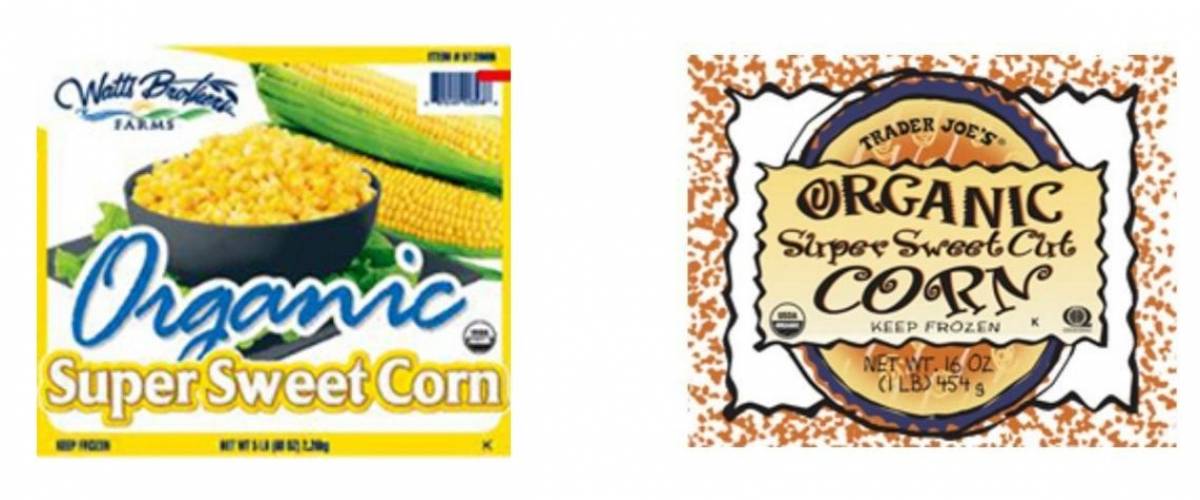
Confirmed.
ConAgra Foods recalled some of its vegetable products in 2016 — including Trader Joe’s Organic Super Sweet Cut Corn — over possible listeria contamination.
One of North America's leading food companies, ConAgra owns a number of iconic brands, from Duncan Hines to Chef Boyardee, and supplies food to restaurants and supermarkets like Trader Joe’s.
Advertisement
8. Bakkavor hummus

Confirmed.
A 2016 recall due to possible listeria contamination pointed to Bakkavor Foods as the maker of two Trader Joe’s hummus flavors: Mediterranean Hummus and White Bean & Basil Hummus.
Advertisement
Bakkavor Foods boasts of being the largest provider of fresh prepared food in the United Kingdom, with an expanding presence in the U.S. and China. It produces items such as dips, salads and ready-to-eat meals for a number of retailers, as well as under its own brand, Yaas!
While we aren’t sure who’s behind Trader Joe’s other hummus flavors, Eater says Tribe Mediterranean Foods was once responsible for a tahini-free version.
Advertisement
7. Bakkavor egg salad and potato salad

Confirmed.
Another FDA recall revealed that Bakkavor Foods isn’t just responsible for Trader Joe’s hummus.
In 2019, the U.K.-based supplier pulled Trader Joe’s Egg Salad and Old Fashioned Potato Salad — again, for possible listeria contamination.
Yet the blame may not fully rest on Bakkavor this time. The recall was announced after supplier Almark Foods notified the company that its Broken Egg Whites, which likely went into the salads, may have been contaminated.
Advertisement
6. Mann’s baby cauliflower

Confirmed.
If you love tossing some of Trader Joe’s Baby Cauliflower florets into your salads, you might want to start calling them by their formal name: CAULILINI®.
Yes, Mann’s has trademarked the name for its own gourmet veggie. Mann’s, which operates as the Del Monte Fresh Produce vegetable division, is one of the country’s leading suppliers of fresh veggies, marketing its produce under its own name as well as supplying private labels.
A 2019 recall of some broccoli, cauliflower and other vegetable products exposed the brand behind Trader Joe’s Baby Cauliflower.
Advertisement
5. La Boulangerie bread

Probable.
Hit up Trader Joe’s bread section to find a brand that started as a small, Starbucks-owned shop.
La Boulangerie, formerly known as La Boulange, produces a range of freshly baked goods from baguettes to pastries and secretly supplies some of its products to Costco and Trader Joe’s, according to Eater.
The food and dining network claims the brand provides Trader Joe’s with its cranberry twist baguettes and the Pain Pascal. The bakery’s founder, Pascal Rigo, also mentioned in an interview with the magazine Bake that Pain Pascal was the first item it introduced to Trader Joe’s.
Advertisement
4. Yorgo’s Foods cilantro & chive yogurt dip and tahini sauce

Confirmed.
Two of Trader Joe’s tangy, Greek-style products were part of another listeria-related recall in 2017.
Yorgo’s Foods removed more than 40 items from store shelves, including Trader Joe's Cilantro & Chive Yogurt Dip and Tahini Sauce, after a factory sample tested positive for the harmful bacteria.
The family-owned company based in Manchester, New Hampshire, prepares Mediterranean foods such as hummus, dips and pita chips and distributes many of its products internationally.
Advertisement
3. Fuji Food ready-to-eat meals

Confirmed.
If you’ve ever perused the ready-to-eat meals at Trader Joe’s on your lunch break, you’ll recognize some of these items.
In 2019, Fuji Food recalled its ready-to-eat sushi, salads and spring rolls from retailers along the East Coast and Upper Midwest. The FDA disclosed that a number of Trader Joe’s items — including its California Rolls, Smoked Salmon Poke Bowl, Banh Mi Inspired Noodle Bowl and Queso Fundido Spicy Cheese Dip — were included in the list of affected products.
Fuji Food also ships items under its Okami brand to stores such as Trader Joe’s and Walgreens and produces sushi at its in-store FujiSan kiosks.
Advertisement
2. Tasty Bite Indian food

Probable.
Got a craving for Indian food but don’t feel like ordering takeout? You could try some of Trader Joe’s ready-to-eat Indian Fare meals, which allegedly get imported straight from the homeland.
Advertisement
Fortune says Tasty Bite is responsible for much of Trader Joe’s Indian food, comparing the similarities between their Punjab Eggplant packs. (The magazine also noted that a Tasty Bite Punjab Eggplant pouch cost $3.39 at a Whole Foods in Manhattan, while the TJ’s version was more than a dollar cheaper.)
Owned by snack conglomerate Mars Food, Tasty Bite says it sources its “all-natural ethnic food” from farms near its factory in India. It says the prepared meals, which include vegetable entrees and ready-to-eat rice and noodle dishes, remain fresh for up to 18 months.
Advertisement
1. Wildway grainless granola

Confirmed.
Health nuts trying to decide between TJ’s private label and Wildway’s grain-free granola need no longer fret over cost and quality.
In 2017, Wildway recalled some grain-free granola products over potential listeria contamination and identified Trader Joe’s Grainless Granola along with its own Grain-Free Granola brand.
Wildway markets its granola, hot cereals and snack mixes as grain and gluten free, claiming “numerous” health benefits to eliminating your intake of grains.
†Terms and Conditions apply.